
The Antikythera Mechanism: The Ancient Machine That Rewrote the History of Technology
By Dnyaneshwar
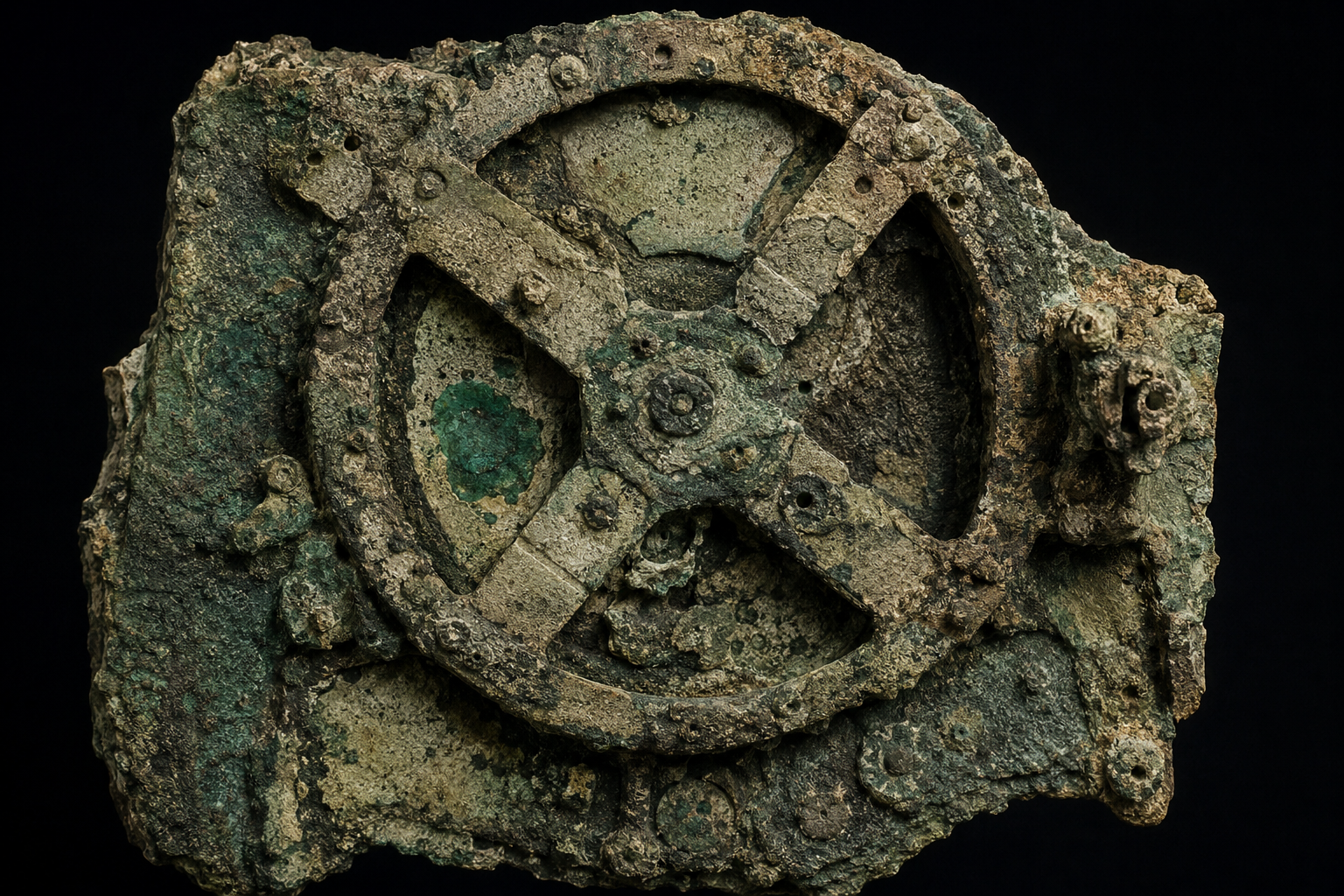
Few archaeological discoveries have challenged our understanding of human history as dramatically as the Antikythera Mechanism. Often described as the world’s first analog computer, this astonishing device was built more than 2,000 years ago by the ancient Greeks, yet its mechanical sophistication rivals technologies that would not appear again until the late Middle Ages.
Discovered accidentally in a shipwreck near the Greek island of Antikythera in 1901, the mechanism remained an unsolved mystery for decades. At first glance, it appeared to be nothing more than a corroded lump of bronze. But hidden inside those fragments was an intricate system of interlocking gears capable of predicting celestial movements, eclipses, lunar phases, and even the timing of the Olympic Games.
Today, the Antikythera Mechanism is regarded as one of the greatest technological achievements of the ancient world a machine so advanced that many historians initially struggled to believe it could have existed in the 2nd century BC.
Discovery of the Antikythera Mechanism
The Shipwreck That Changed History:
In 1901, sponge divers exploring the waters near the Greek island of Antikythera discovered the remains of an ancient Roman-era shipwreck. Alongside statues, pottery, jewelry, and other artifacts, archaeologists recovered several corroded bronze fragments unlike anything ever seen before.
For years, researchers believed the fragments were simply remnants of a damaged astronomical instrument. However, closer examination revealed tiny gear teeth embedded within the bronze. This immediately raised questions, because no known machine from antiquity possessed such mechanical complexity.
The wreck itself is believed to date to around the 1st century BC, while the mechanism is thought to have been manufactured sometime between 100 and 200 BC during the Hellenistic period an era marked by remarkable advancements in Greek science, mathematics, and astronomy.
What Was the Antikythera Mechanism?
The World’s First Analog Computer:
The Antikythera Mechanism was essentially a mechanical astronomical calculator. Encased in a wooden box roughly the size of a shoebox, it contained at least 30 bronze gears connected through highly sophisticated gear trains.
By turning a hand crank, the user could simulate the motion of celestial bodies across time. The mechanism translated rotational movement into precise astronomical calculations, functioning in many ways like an ancient computer.
Its primary purpose was to model the cosmos according to the astronomical knowledge of the ancient Greeks.
Main Functions of the Mechanism
One of the device’s most impressive capabilities was its ability to track the movements of celestial bodies.
The mechanism could calculate the positions of:
The Sun
The Moon
Mercury
Venus
Mars
Jupiter
Saturn
These were the five planets visible to the naked eye and known to ancient Greek astronomers.
Using complex gear ratios, the machine recreated the apparent movement of these bodies across the zodiac. Modern reconstructions suggest the front display likely showed a miniature moving model of the heavens.
Predicting Solar and Lunar Eclipses:
The mechanism was also capable of predicting eclipses years or even decades in advance.
Ancient Greek astronomers understood that eclipses followed repeating cycles. The Antikythera Mechanism encoded these cycles mechanically using carefully designed gear trains.
One of the most important was the Saros cycle:
223 synodic months≈18 years 11 days
After this period, solar and lunar eclipses repeat in a similar pattern.
The machine also tracked the Exeligmos cycle, which refined eclipse timing further by compensating for time-of-day drift across multiple Saros cycles.
This level of predictive astronomy was extraordinarily advanced for the ancient world.
The Olympic Games Calendar:
The mechanism was not limited to astronomy alone.
One of its calendar systems tracked the four-year cycle of the ancient Olympic Games along with other major Panhellenic festivals. This demonstrates that the machine served both scientific and cultural purposes.
For the Greeks, astronomy, religion, civic life, and mathematics were deeply interconnected, and the mechanism reflected that worldview perfectly.
The Most Advanced Feature: The Lunar Mechanism
Modeling the Moon’s Irregular Orbit:
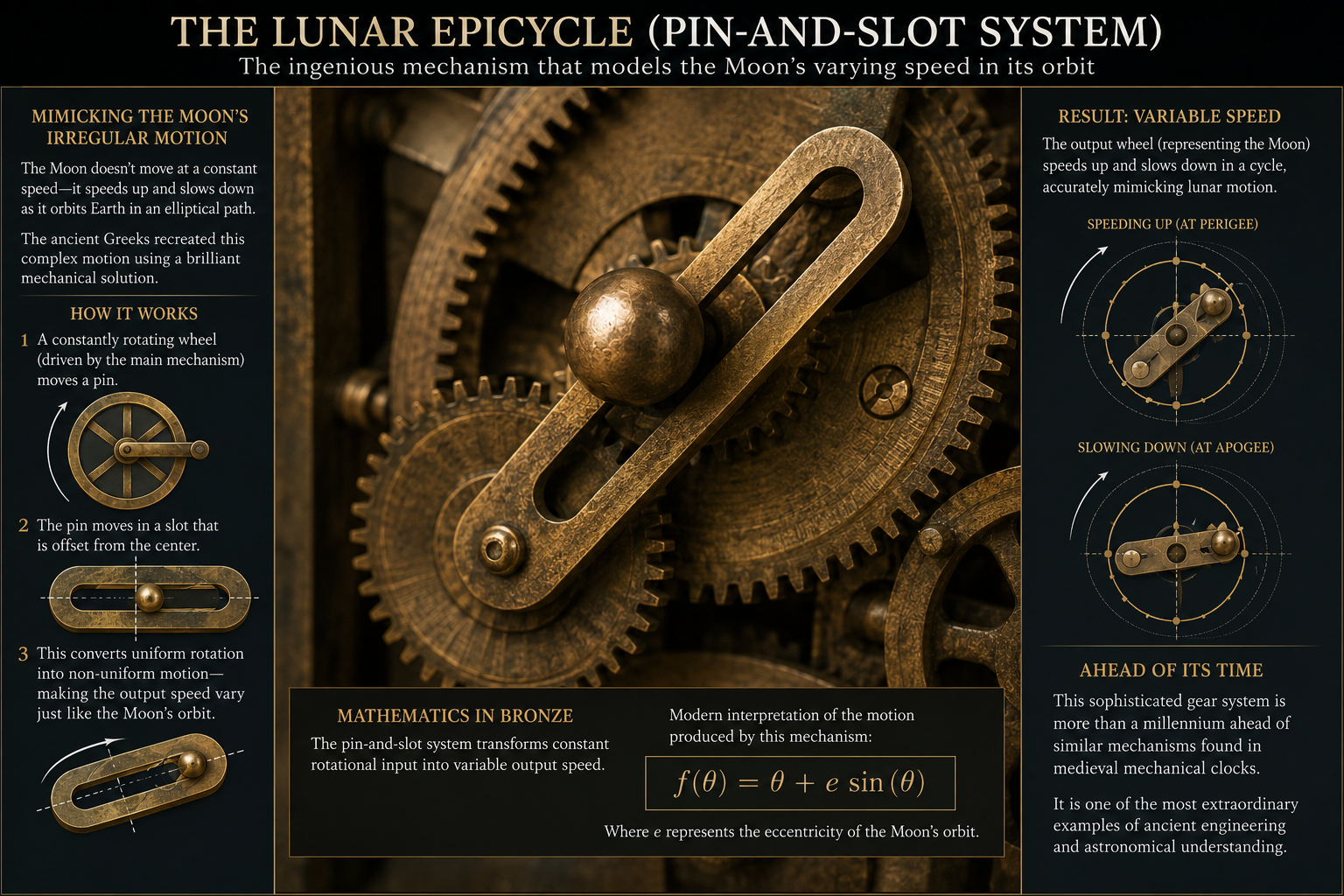
Perhaps the most astonishing component of the Antikythera Mechanism was its lunar motion system.
Unlike the Sun, the Moon does not move across the sky at a constant speed because its orbit is elliptical. Ancient Greek engineers somehow developed a mechanical solution to represent this irregular motion using epicyclic gearing.
The system used a remarkable pin-and-slot mechanism that converted constant rotational input into variable output speed.
Modern interpretations approximate this motion mathematically as:
f(θ)=θ+esin(θ)
This means the mechanism could mechanically imitate changing orbital speed a concept requiring deep understanding of geometry, astronomy, and mechanical engineering.
What makes this even more remarkable is that comparable mechanical sophistication would not appear again for more than a millennium.
Engineering Beyond Its Time
Why the Mechanism “Shouldn’t Exist”
The Antikythera Mechanism fundamentally changed historians’ understanding of ancient technology.
Before its discovery, many scholars believed precision gearing of this complexity first emerged in medieval Europe during the development of mechanical clocks in the 14th century.
Yet the Antikythera Mechanism predates those inventions by nearly 1,500 years.
Its construction required:
Precision-cut bronze gears
Advanced mathematical ratios
Miniaturized engineering
Complex mechanical planning
Accurate astronomical knowledge
After the collapse of the Hellenistic world, technology of this sophistication appears to disappear completely from the historical record.
This has led many researchers to believe the mechanism was not an isolated invention, but part of a broader lost tradition of Greek scientific engineering.
Decoding the Ancient Machine
Modern Technology Reveals Ancient Secrets
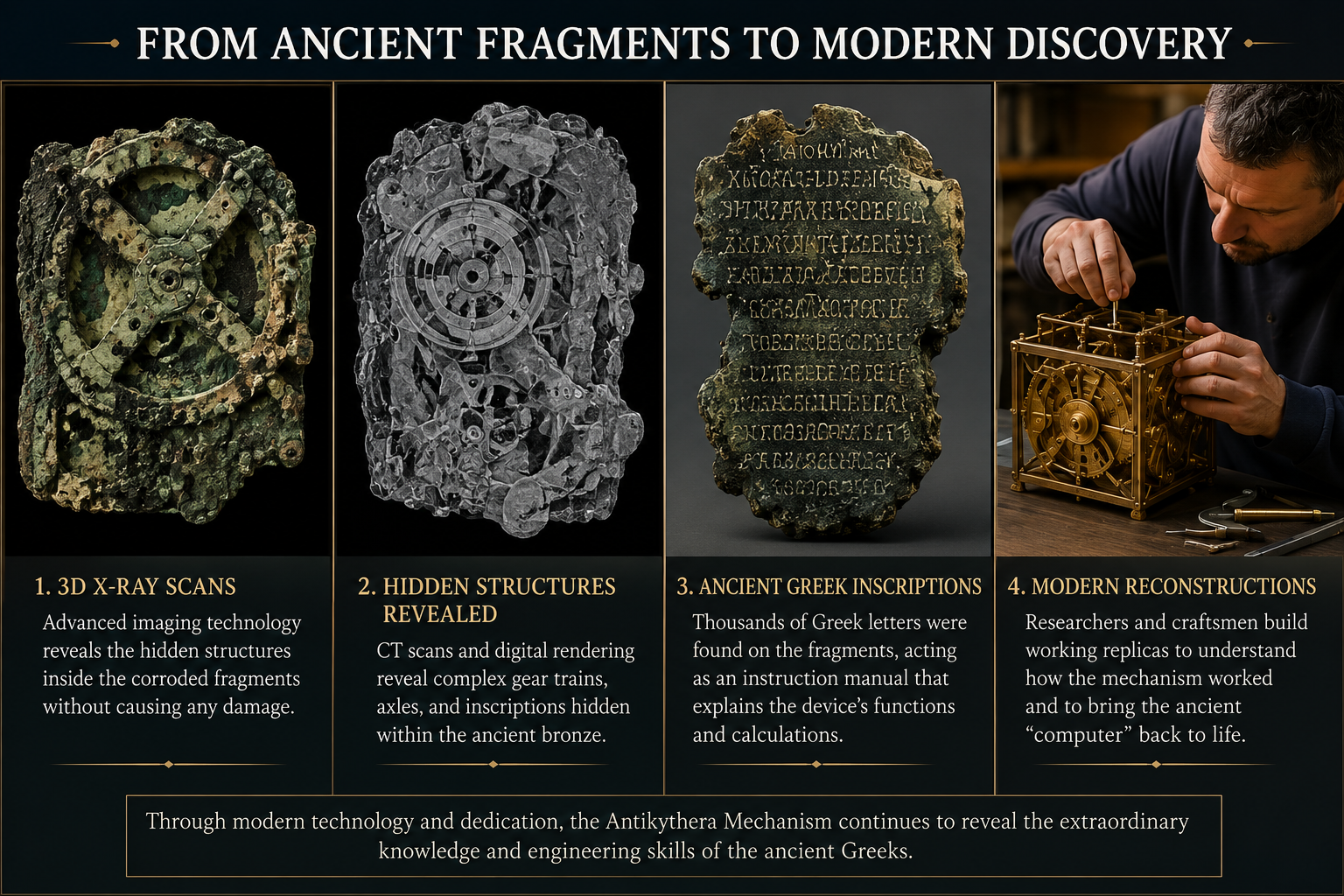
For decades, scientists could only study the outer surfaces of the corroded fragments. Much of the mechanism’s internal structure remained hidden.
Everything changed with modern imaging technology.
Using:
3D X-ray scanning
CT imaging
Digital reconstruction
Advanced photography
researchers were finally able to look inside the fragments without damaging them.
These scans revealed hidden gear trains, inscriptions, and thousands of tiny Greek characters engraved into the bronze.
The inscriptions functioned almost like a user manual, explaining parts of the device’s operation and confirming many theories about its astronomical functions.
Reconstructing the Mechanism
Experimental Archaeology and Modern Replicas
Modern craftsmen and researchers have built working reproductions of the Antikythera Mechanism to better understand how it operated.
These reconstructions demonstrate:
the precision of the gear systems,
the complexity of the astronomical calculations,
and the extraordinary craftsmanship of ancient Greek engineers.
Experimental archaeology has also explored how the Greeks may have manufactured such accurate gears using relatively simple tools such as:
hand files,
bow lathes,
dividers,
drills,
and bronze casting methods.
These experiments suggest that ancient artisans achieved precision not through modern machinery, but through skill, geometry, patience, and iterative craftsmanship.
More than 2,000 years after it was built, the Antikythera Mechanism continues to astonish the modern world.
What began as a corroded collection of bronze fragments has become one of the greatest scientific discoveries in archaeological history. It reveals an ancient civilization capable of blending astronomy, mathematics, engineering, and craftsmanship into a functioning mechanical model of the cosmos.
Its gears tracked planets, predicted eclipses, calculated calendars, and modeled lunar motion with astonishing sophistication. Yet perhaps its greatest achievement is the way it transformed our understanding of the ancient world.
The Antikythera Mechanism reminds us that history still holds mysteries capable of reshaping everything we think we know about human ingenuity.